
American manufacturing is going through a massive shift. Considering high-cost labour, inconsistent supply chains, and continuously changing markets, traditional manufacturing processes can no longer keep up. The integration of Industry 4.0 technologies into manufacturing provides plant managers with a clear roadmap to digitally connect existing equipment, implement automated quality inspections, and make data-driven decisions throughout the process.
Rather than thinking of digitalization as a fixed, inflexible checklist of steps, the best-managed factories implement it according to a dynamic roadmap. Such an approach allows you to move from your current manufacturing process level by level without interrupting your operational line.
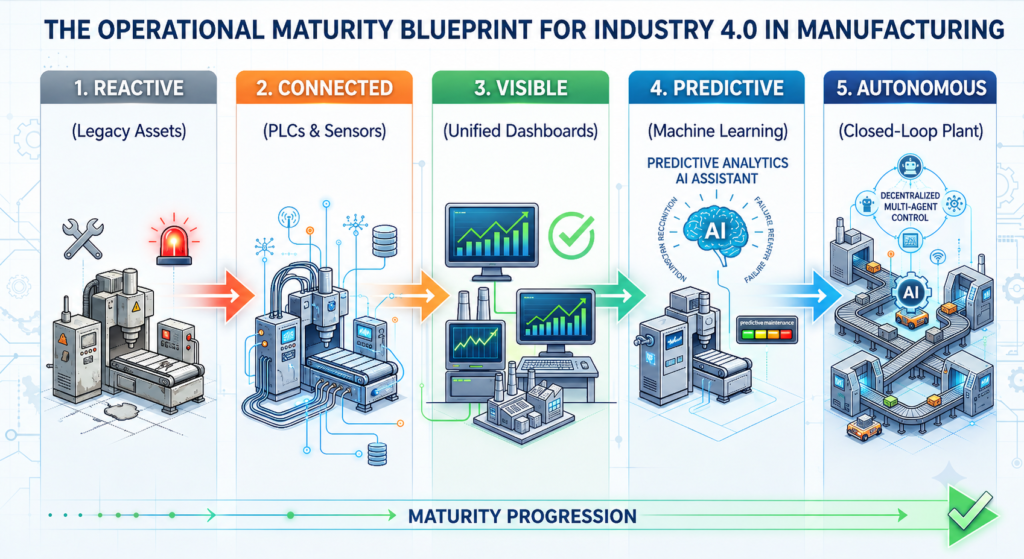
The Operational Maturity Blueprint for Industry 4.0 in Manufacturing
Industrial Connectivity Standardization
Any manufacturing floor has a combination of newly introduced systems operating side-by-side with machines built years ago. Connecting old technology to the new world is difficult without overcoming the old gap between operational technology and enterprise IT.
With edge gateways introduced to existing programmable logic controllers (PLCs) with non-invasive industrial internet of things (IIoT) sensors installed on crucial machinery, teams will be able to collect key performance indicators (KPIs), such as thermal outputs, vibrations, and cycle times.
According to the research by Fortune Business Insights, the global IIoT market in the manufacturing industry will amount to $673.95 billion by 2032 due to fast adoption in industries.
Cross-facility Visibility
Data collection is always great, but it doesn’t give anything unless used properly. The current stage is about collecting shop-floor data and connecting it to scalable cloud architecture and ERP and MES through integration.
This way, all processes will be unified in one convenient dashboard, which will close the communication gap between operators, process engineers, and executives.
As reported by McKinsey, a targeted smart factory adoption would reduce unplanned downtime for machines between 30% and 50%, provided that the initiative is linked to specific goals of operation.
From Reactive to Predictive Operations
When data becomes clean and structured, the facility gains the opportunity to shift from reactive maintenance and a rigidly scheduled calendar to machine learning algorithms that would analyze live telemetry data in comparison with the historical baseline and detect any wear of equipment before failure occurs.
It is at this stage that computer vision artificial intelligence technologies become engaged in visual inspection of production lines that detect any defects at full speed.
IBM research shows that smart manufacturing could increase defect detection up to 50% as well as improve production yields by 20%.
Closed-Loop Autonomy
On the final level of maturity, plant systems not only notify you about issues but also solve them. Digital twins continually model the workflow process, optimize job routing based on the status of bottlenecks, regulate energy consumption during peak-rate hours, and adjust precision tool parameters.
According to Deloitte, 41% of manufacturers currently give priority to factory automation hardware in their capital budget planning.
Overcoming Real-World Execution Barriers
Even when the ROI is obvious, taking a plant digital comes with real operational hurdles. Knowing how to navigate these common roadblocks keeps your rollout moving forward on budget and on schedule.
Bridging Legacy System Gaps
Facilities rarely have the luxury of replacing working machines just because they’re old. Converting legacy, proprietary machine protocols into standardized data streams requires reliable edge protocol converters and OPC UA frameworks before sending anything to the cloud.
Managing Capital Investment
Upgrading industrial hardware and securing software licensing takes real capital. Strategic plant managers keep risk low by starting with small, modular micro-projects—like monitoring a single high-impact stamping press, to prove out ROI before expanding across the facility.
Upskilling the Workforce
However advanced the tools are, they can be no better than the users of those tools. Sustainability will require giving them easy-to-use software interfaces, easy notifications, and sufficient training so that they see themselves as empowered by the new technology rather than replaced by it.
Best Practices for Execution Success
To implement Industry 4.0 successfully in manufacturing is to map technology with operational maturity.
- Concentrate on High-Priority Pain Points First:Address your most pressing pain points, such as unexpected downtime of your bottleneck equipment, not trying to boil the ocean from the beginning by performing a complete factory-wide transformation.
- Empower Your Teams: Provide your operators with intuitive mobile dashboards where complicated data becomes actionable every single day.
- Build in Zero-Trust Security: Secure your converging OT/IT infrastructure using access control and micro-segmentation.
Table of Contents
How Saxon AI Enables Modern Manufacturing
Saxon AI helps manufacturers solve the technology gap between manufacturing hardware and enterprise software by creating custom solutions:
- Enterprise AI Integration: Effortless integration of PLCs, MES, ERP, and QMS into the data fabric, and providing insights that can be assessed easily in the organization.
- Agentic Automation: Developing unique AI agents and multi-agent systems that handle predictive maintenance tickets, inventory, and create quality reports.
- Engineering for Cloud and Azure: Developing efficient edge-to-cloud architecture that processes large machine data without any latency and cybersecurity issues.
The effective evolution through all levels of maturity is also dependent on proper data infrastructure and unique technical expertise.
Frequently asked questions
Industry 4.0 smart manufacturing is the incorporation of cyber-physical systems, IoT sensors, and cloud computing into factory operations. This means the transformation of regular assembly line operations to connected ones.
Use of Industry 4.0 solutions would enable businesses to maximize their OEE, prevent unexpected downtime, reduce costs of operation, and adjust production quantity to meet market demands.
With AI manufacturing solutions in Industry 4.0, businesses can carry out predictive maintenance, computer vision quality control, and dynamic yield optimization using shop floor data, avoiding machine failure and defects.
Some of the challenges firms may face include high investment costs, difficulties in integrating existing machinery, security threats, and lack of skilled manpower.
Organizations need to start by making investments in those projects that offer higher return on investment (ROI), training employees, ensuring cybersecurity, and implementing solutions of Industry 4.0 that will easily fit into their existing system.