

Azure Well-Architected Framework (WAF)
Reliability
Applications running on the cloud are susceptible to failures. For example, an individual server can fail, a cyberattack might encrypt all the data, or power goes off at the data center due to a tornado. For a business, a minute’s downtime can have catastrophic consequences. You must design your workloads on the cloud for resilience. Resilience helps you restore the workload in case of failure with little to no effect.
To help you architect reliable and highly available workloads on Azure cloud, Microsoft’s Azure Well-Architected Framework offers you some best practices. The practices include considerations for selecting the right services, optimizing workloads, and using caching mechanisms effectively.
Security
Data is wealth. Data protection is paramount. You might be saving sensitive customer data or critical information about your financials. Should this information get exposed, it can damage your brand reputation and substantially harm your business. So, ensuring compliance and the integrity of your data is essential.
The Azure cloud provides security against threats. However, you need to build additional security layers into your workloads and processes to strengthen security. In the security pillar, Azure Well-Architected Framework proposes security measures and best practices for identity management, application and infrastructure protection, data sovereignty, and security resources management.
Cost optimization
Operational excellence
You moved to Azure cloud services. Is the job done? Besides enhancing your technical capabilities, the Azure platform also empowers your business with operational capabilities, such as agility in development and real-time visibility into application health and performance. How, you ask?
You can achieve operational excellence on the Azure cloud using the best practices provided in the Operational Excellence pillar in the Azure WAF. This pillar focuses on ensuring efficient operations of your applications and infrastructure. It emphasizes modern practices for designing, building, and orchestrating your cloud architecture. The pillar also provides some Azure best practices, such as automating tasks, monitoring performance, incident response, and continuous improvement.
Performance efficiency
Imagine you are a retailer and launching an exclusive sale. Your audiences receive it well, and you experience a huge influx of traffic to your application. Can your application handle it? Should it crash, it will cost your business. You need to build your workloads for scalability because performance inefficiencies are expensive.
In the Performance efficiency pillar, the focus is on designing your Azure resources to deliver high performance and efficiency. This pillar provides the best practices for selecting the right services, optimizing network and storage performance, identifying performance bottlenecks, and using caching mechanisms effectively.
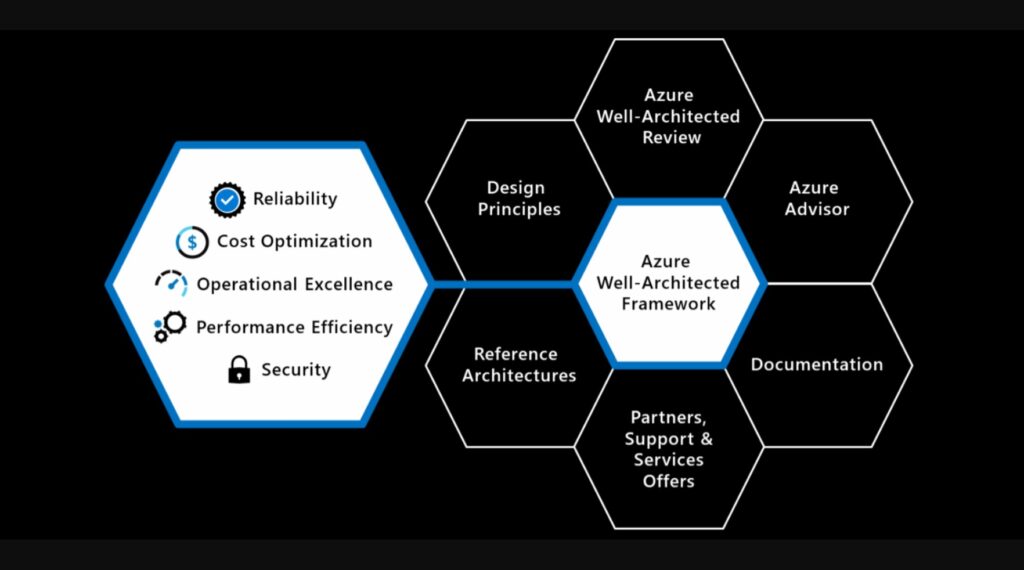
Source: Microsoft
The Well-Architected Framework provides a structured approach to evaluating your architecture against these pillars and identifying areas for improvement. It offers guidance in the form of documentation, best practices, and tools to help you make informed decisions about your cloud architecture.
Microsoft provides a Well-Architected Review tool within the Azure portal that allows you to assess your workloads against these pillars and get recommendations for improvements. This tool helps you align your architecture with the best practices outlined in the framework.
Advantages of implementing Azure Well-Architected Framework
- Consistency and standards: The WAF promotes a standardized approach to architecture design and implementation, ensuring that all projects within your organization adhere to the same set of best practices.
- Scalability: The scalability guidelines provided by the WAF enable you to design architectures that can scale up or down seamlessly based on changing demands, ensuring your applications can handle increased workloads.
- Risk mitigation: Following the WAF helps identify and mitigate risks early in the design phase, reducing the likelihood of security breaches, performance issues, and operational disruptions.
- Alignment with industry standards: The WAF is based on industry best practices and lessons learned from real-world scenarios, ensuring that your cloud architecture aligns with industry standards and proven strategies.
- Continuous Improvement: The WAF fosters a culture of continuous improvement by providing mechanisms for reviewing and refining architectures over time, ensuring that your cloud environments stay up-to-date and relevant.
- Competitive Advantage: Implementing the WAF demonstrates your commitment to building reliable, secure, and efficient cloud solutions, which can give your organization a competitive advantage in the market.
Why you need a technology partner for implementing Azure Well-Architected Framework
Expertise and experience
Accelerated implementation
Problem-solving
Continuous support
Risk mitigation
Faster ROI
Focus on core business
Change Management
Looking for a trusted technology partner to implement Azure WAF?
We are here for you! At Saxon, we are helping SMEs and corporates move to the Azure cloud and transform their operations. Our Azure experts understand your unique business needs and help you effectively implement the Azure Well-Architected Framework for your cloud journey success.
Want to talk to our experts?