

Modern Work

/

Low-Code/No-Code Development

Low-Code/No-Code Development

Build applications faster with reduced dependency on traditional development.
Design and deliver low-code and no-code applications that enable rapid development, improve agility, and support collaboration between business and IT teams.

Trusted by Leading Brands

Trusted by 100+ global companies across Retail, Manufacturing, Healthcare, Finance, and Technology


Our low-code/no-code development approach

Application development

  • Line-of-business application development 
  • Rapid delivery using visual development tools 
  • Integration with existing enterprise systems 

Process automation

  • Workflow automation for business processes 
  • Reduction of manual and repetitive tasks 
  • Automation embedded within applications 

Data and insights

  • Unified data access across systems 
  • Dashboards and reports for decision support 
  • Analytics embedded within applications 

Enterprise integration

  • Application and data integration 
  • Cloud and on-prem system connectivity 
  • Consistent and reliable workflows 

What our low-code/no-code services deliver

Faster

application delivery cycles

Improved

collaboration between business and IT 

Reduced

development effort and cost

Flexible

applications that evolve with business needs
Proven outcomes at enterprise scale

40-60%

faster hiring cycles

50%

reduction in onboarding effort

30%

improvement in recruiter productivity

25%

lower voluntary attrition

35%

faster HR request resolution

100%

audit-ready compliance

Integrations

outlook
sap
Teams
netsuite
Zoom

AIssist — An Enterprise Platform for AI at Work

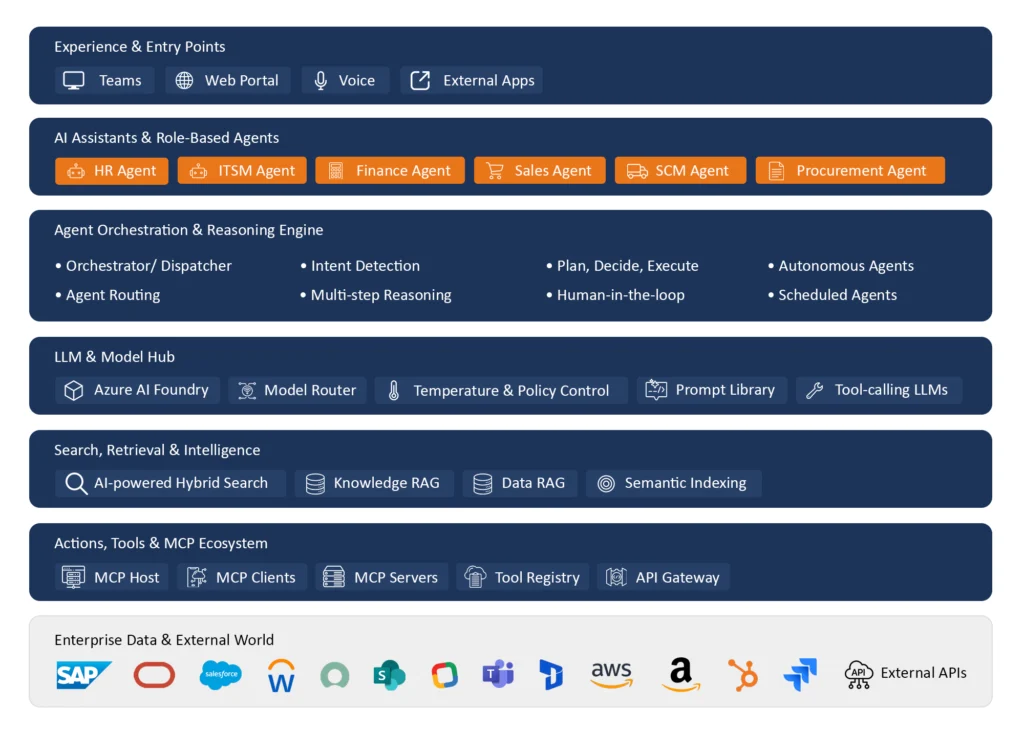
AIssist is an enterprise platform designed to help organizations work smarter with AI. It brings intelligence, search, and action together in one secure layer—so teams can find information, make decisions, and execute tasks across systems without switching tools. Built to fit into existing enterprise environments, AIssist connects data, applies controls, and supports consistent execution at scale.

One Platform. Three Core Capabilities.

Integrations

outlook
sap
Teams
netsuite
Zoom

Proven Success with Enterprise Clients

Project Financial Health Copilot

Project financial visibility depended on delayed and manual reporting, limiting proactive control. An AI-powered financial copilot provides conversational access to real-time project metrics, forecasts, and risk indicators. Project leaders gain faster insight into financial health and can take corrective action earlier

Doctor Assist Copilot for OPD

Doctors spent significant time reviewing patient records before consultations, reducing patient throughput. An AI copilot aggregates patient history, diagnostics, and clinical notes into a single view, enabling faster reviews and more informed consultations.

RPA-Based Sales Order Automation

Manual sales order processing led to delays and errors. An RPA-driven automation integrated with SAP streamlined order creation and processing, reducing manual effort, improving accuracy, and enabling faster order execution with better customer satisfaction.
technology-integrated-everyday-life

AI-Powered LPO and Reconciliation Automation

Manual processing of LPOs and reconciliations resulted in delays, mismatches, and compliance risks. An AI-powered automation extracts LPO data from emails, validates and reconciles transactions, and integrates directly with SAP. Structured outputs and audit trails improved accuracy, reduced manual effort, and strengthened compliance.

How We Engage

Identify suitable use cases and development priorities. 

Define application scope, workflows, and integrations.

Develop applications using low-code / no-code platforms.

Connect applications with enterprise systems and data. 

Enhance applications as needs change. 

Frequently Asked Questions (FAQs)

Low-code development uses visual tools and pre-built components to build applications with minimal coding.

No-code development enables business users to build applications without writing code, using visual interfaces. 

It is ideal for rapid application development, prototyping, and process automation.

Yes. Applications can integrate with enterprise systems using connectors and APIs.

Yes. Enterprise platforms provide role-based access, security controls, and compliance features. 

Yes. Low-code platforms support scalable and complex applications when designed correctly.

Take the next step