

Your Active pharma ingredients (API) manufacturer/supplier just changed an analytical method. Small change, they say. Routine improvement.
Somewhere in your organisation, that notification arrived, probably in a procurement inbox. It got forwarded. Then forwarded again. By the time it reached your regulatory affairs team, a week had already passed without a single assessment being done.
For API changes, the stakes are higher than most. A specification update, a process adjustment, a new analytical method – any of these can trigger regulatory filing obligations across multiple markets at once.
The clock starts the moment your supplier makes the change. Your window to assess, classify, and respond is already running, whether your team knows it or not.
Why the delay compounds at every stage of API change management?
Fragmented data
Manual impact assessment
Table of Contents
Approval bottlenecks at every handoff
The notification moves from supplier to procurement to quality to regulatory affairs — each step manually triggered, each dependent on someone noticing, forwarding, and acting. Without automated routing or escalation logic, changes sit in “pending” status when a key stakeholder is unavailable. Nobody has a live view of where a notification is in the process.
Regulatory complexity across markets
Managing differing requirements across FDA, EMA, PMDA, CDSCO, and dozens of other agencies — each with their own classification criteria, timelines, and documentation standards — creates information overload before remediation work even begins. Teams end up reactive, chasing what’s urgent rather than managing what’s strategic.
These four gaps don’t operate independently. Each one extends the next. A delay in data gathering delays the impact assessment. A delayed assessment delays routing. Delayed routing delays the filing decision. By the time the right person has the full picture, weeks have passed — and the supplier may have already moved to the new process.
How is AI closing the gap in API Change management?
Intelligence layer across systems
An intelligent layer that integrates across systems like ERP, QMS, LIMS, and DMS brings data together that was previously scattered. When a notification arrives, the full context with details like affected products, registered markets, relevant dossier sections, is already assembled. No data mining. No manual cross-referencing.
AI-driven impact assessment
Agentic AI workflows automatically map incoming Active pharma ingredients change against your approved portfolio, flagging affected products and regulatory filing obligations by market. What currently takes weeks is reduced to days. The regulatory decision stays with your team. The groundwork doesn’t have to.
Intelligent routing and triage
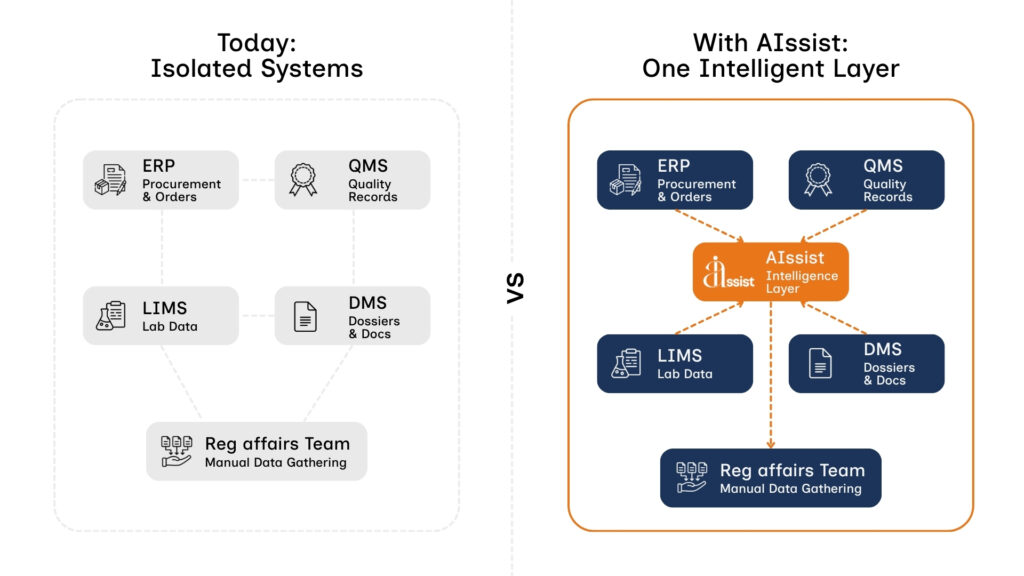
Saxon AI's AIssist – Agentic Enterprise AI platform addresses this as an orchestration problem. It comes as an intelligence layer embedded into your existing pharma workflows. By combining enterprise data, governed AI agents, and traceable outputs with full audit trails, it help teams move from fragmented coordination to aligned execution.
On a closing note
Global regulatory timelines vary by market, and harmonising them is a long-term industry challenge. That part is outside your control.
But the coordination overhead inside your organisation like fragmented data, manual handoffs, sequential approvals, reactive triage can be fixed. That’s exactly where structured workflow automation and AI for pharma industry can close the gap.
Saxon AI works with regulatory affairs and supply chain leaders in pharma to automate API change management workflows, from supplier notification through impact assessment to submission coordination. If this is a conversation worth having, we’re ready.