
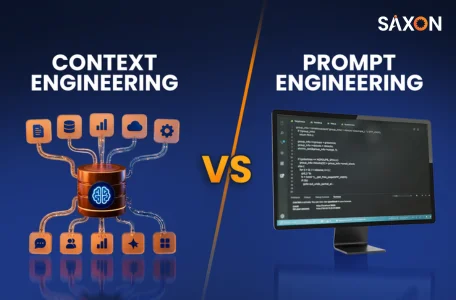
Prompt engineering scales by repeating instructions. Context engineering scales by reusing intelligence.
For the past few years, enterprises have invested heavily in learning how to write better prompts.
That made sense.
A better prompt could improve the quality of an LLM response almost immediately. We learned to give models clearer roles, better examples, output formats, constraints, business rules, and increasingly detailed system instructions.
But something changes when an organization moves beyond experimentation.
You no longer have five prompts supporting one chatbot.
You may have dozens of copilots, hundreds of agents, enterprise search experiences, analytical assistants, workflow agents, and AI embedded inside business applications.
And every one of them starts accumulating instructions.
At some point, a different question becomes more important:
Why are we teaching every AI application the same things over and over again?
That is where the shift from Prompt Engineering to Context Engineering begins.
Not because prompt engineering stops mattering.
But because repeatedly encoding enterprise intelligence into prompts can become an expensive way to scale AI.
Prompt Engineering vs Context Engineering
The distinction is actually simple.
Prompt Engineering asks:
How should the AI perform this task?
Context Engineering asks:
What does the AI need to know to perform this task correctly?
That difference has major implications for enterprise architecture.
Table of Contents
| Prompt Engineering | Context Engineering |
Core question | How should the AI work? | What should the AI know? |
Main asset | Prompt | Context |
Business knowledge | Often embedded in instructions | Retrieved dynamically |
Reuse | Usually application-specific | Shared across agents |
Change management | Update prompts | Update source/context |
Security | Often expressed as instructions | Enforced during retrieval |
Economics | Low initial cost, growing maintenance | Higher foundation cost, greater reuse |
At scale | Can create prompt debt | Creates reusable infrastructure |
Prompt engineering is primarily about instruction.
Context engineering is about information, meaning, relationships, state, and evidence.
The First Prompt Is Cheap. The 500th Isn't.
Consider a supply-chain manager asking:
What is the impact of the disruption at Supplier X?
A good prompt might say:
Act as a supply-chain risk analyst. Identify affected products, plants, customer orders, and revenue. Consider inventory, alternate suppliers, customer priority, contractual commitments, and lead times. Recommend mitigation actions based on business impact.
That is a perfectly reasonable prompt.
But now the real questions begin.
- What exactly does the organization mean by available inventory?
- Which customers count as strategic customers?
- How should revenue at risk be calculated?
- Which application contains the authoritative supplier relationship?
- Where are contracts stored?
- What happens when SAP and Salesforce disagree?
- Which data is the person asking the question authorized to see?
A prompt can tell the AI what analysis to perform.
It cannot manufacture business context that it does not have.
So teams begin adding more instructions.
The prompt grows:
When calculating available inventory…
When identifying strategic customers…
Always use SAP for order status…
Use MDM for customer hierarchy…
Do not expose margin unless…
If CRM and ERP disagree…
Revenue should mean…
Before long, the prompt is doing far more than instructing the model.
It is becoming a repository of enterprise business rules.
And that creates what I would call:
Prompt Debt
Prompt debt accumulates when business definitions, policies, source priorities, exceptions, security guidance, and workflow logic become duplicated across AI applications.
The problem is not the first prompt.
The problem is maintaining the same logic across the next 50, 100, or 500.
The Hidden Cost Is Bigger Than Tokens
When we talk about prompt cost, people often think about token consumption.
That matters.
A 10,000-token system prompt sent repeatedly through thousands of interactions absolutely affects inference cost.
But the operational cost is much broader.
Someone must:
- design the prompt,
- test it,
- version it,
- maintain it,
- regression-test changes,
- tune it for different models,
- govern the business logic inside it,
- and troubleshoot it when responses change.
Now imagine Finance changes the definition of revenue.
How many prompts contain the old definition?
How many applications need to be retested?
How many teams independently encoded slightly different versions of that same rule?
The true cost of prompt-heavy architectures starts looking more like:
Prompt TCO =
Prompt Development
- Maintenance
- Regression Testing
- Governance
- Repeated Token Usage
- Model-Specific Tuning
- Duplication Across Applications
This is manageable when the enterprise has a handful of AI use cases.
It becomes much harder when AI becomes an enterprise-wide capability.
Context Engineering Changes the Economics
Context engineering starts with a different architectural idea:
Do not repeatedly encode enterprise knowledge into every prompt. Make that knowledge reusable.
Take a simple example.
Instead of telling every AI application:
Available Inventory = On Hand – Allocated – Quality Hold – Safety Stock – Blocked Inventory
define that metric once in the enterprise semantic or context layer.
Now every authorized AI application can consume the same definition.
Instead of:
Agent 1 → Business Definition
Agent 2 → Business Definition
Agent 3 → Business Definition
Agent 4 → Business Definition
We move toward:
Shared Enterprise Context
↓
Agent 1 | Agent 2 | Agent 3 | Agent 4 | Agent N
That changes the cost curve.
Prompt engineering generally has a low starting cost.
Context engineering typically requires more upfront investment in things such as:
- semantics,
- retrieval,
- identity,
- permissions,
- entity resolution,
- provenance,
- knowledge services,
- memory,
- and context orchestration.
For one chatbot, that may be unnecessary.
But the economics look very different when the enterprise reaches the 50th or 500th AI application.
The better question is not:
Which approach is cheaper for the first use case?
It is:
Which architecture has the lower marginal cost for the next hundred use cases?
That is where context engineering becomes compelling.
Prompt Engineering Repeatedly Converts Knowledge Into Tokens
There is another way to understand the difference.
A prompt-centric approach often does this:
Enterprise Knowledge
↓
Natural-Language Instructions
↓
Prompt Tokens
↓
Repeated Every Time the Model Is Called
The organization may repeatedly pay to present the same business rules to the model.
Context engineering changes the pattern:
Enterprise Knowledge
↓
Shared Context Infrastructure
↓
Retrieve What Matters for This Task
↓
Right-Sized Context
↓
Inference
The key difference is selective reuse.
Instead of telling every AI application everything it could possibly need to know, we dynamically determine what it needs to know now.
That can improve both reliability and economics.
More Context Is Not Better Context
This is an important distinction.
Context engineering does not mean giving the LLM everything.
An enterprise may contain:
- millions of documents,
- billions of database records,
- years of emails and meetings,
- hundreds of applications,
- thousands of employees,
- enormous amounts of operational history.
Clearly, all of that should not enter the model’s context window.
The objective should be:
Minimum Sufficient Context
The smallest amount of trustworthy information required to complete the task correctly.
A good context-engineering runtime might work like this:
Understand the user’s intent
↓
Determine what information is needed
↓
Retrieve relevant data and knowledge
↓
Resolve business meaning
↓
Apply permissions
↓
Rank evidence
↓
Assemble context
↓
Reason
↓
Determine the next information gap
↓
Retrieve again if needed
This is especially important for agents.
An agent performing 50 steps should not necessarily carry every search result, SQL response, API output, failed hypothesis, and intermediate observation into step 51.
Some information should remain.
Some should be summarized.
Some should be retrieved again later.
Some should disappear.
The challenge is not simply creating context.
It is managing the lifecycle of context.
A Simple Enterprise Example: Customer Context
Suppose 30 enterprise agents need to understand a customer.
A prompt-centric implementation might independently tell each application:
Customer hierarchy comes from MDM.
Strategic customer classification comes from CRM.
Revenue and margin come from Finance.
Open orders come from SAP.
Support risk comes from ServiceNow.
Contracts come from SharePoint.
Regional sellers should not see global margin.
Thirty applications can each encode some version of those instructions.
Or the enterprise can expose a reusable capability such as:
get_customer_context(customer_id, user_identity)
That context could contain:
- customer and parent organization,
- segment,
- revenue and margin,
- open pipeline,
- open orders,
- service cases,
- contract relationships,
- customer risk,
- user permissions,
- and evidence sources.
Now all 30 agents consume the same context foundation.
When the customer hierarchy changes, we do not rewrite 30 prompts.
When Finance changes a metric, the semantic source changes.
When access policy changes, authorization changes centrally.
This is not just a better architecture.
It is a reduction in operational duplication.
Better Context May Also Let Us Use Smaller Models
This creates another interesting economic opportunity.
When context is poor, organizations often compensate by using a more capable and more expensive model.
The thinking is:
Maybe the larger model can figure it out.
Sometimes it can.
But what happens when the model receives:
- resolved entities,
- authoritative metrics,
- explicit relationships,
- relevant evidence,
- current business state,
- and a clearly defined task?
The reasoning problem becomes much more constrained.
In some cases:
Weak Context + Very Large Model
may be replaced with:
High-Quality Context + Right-Sized Model
This will not apply to every task.
Model capability still matters enormously.
But context gives enterprises another optimization lever.
Instead of simply asking:
Which is the smartest model?
we can ask:
What is the least expensive model that can reliably solve this task when provided with high-quality context?
That is a more useful question for Enterprise AI economics.
Context Can Reduce Model Dependency Too
Prompt-heavy systems frequently become model-specific.
A prompt carefully tuned for one model may behave differently on another.
Organizations can therefore end up maintaining:
- one prompt for GPT,
- another for Claude,
- another for Gemini,
- another for a smaller specialized model.
But enterprise context should be more portable.
A customer hierarchy does not change because the model changes.
A permission does not change.
A supplier-product relationship does not change.
A revenue definition does not change.
This creates an important architectural separation:
Enterprise Intelligence
↓
Context Layer
↓
Model A | Model B | Model C
Models become more interchangeable because organizational intelligence lives outside the model.
Eventually, Context Becomes Infrastructure
For one application, context engineering can live inside the application itself.
But once an enterprise has dozens or hundreds of agents, rebuilding the same capabilities repeatedly stops making sense.
This is where context engineering evolves into an Enterprise Context Layer.
Conceptually:
Enterprise Systems & Knowledge
ERP | CRM | SCM | M365 | ITSM | Databases | Documents | APIs
↓
Semantic & Knowledge Foundation
Entities | Relationships | Metrics | Definitions | Ontology | Knowledge
↓
Enterprise Context Layer
Retrieve • Resolve • Rank • Secure • Remember • Reconcile • Assemble
↓
Context API
↓
Agents | Copilots | Search | AI Applications
The Context Layer becomes the bridge between enterprise reality and AI reasoning.
And perhaps the simplest argument for it is this:
The 51st agent should not have to rediscover how the enterprise works.
That knowledge should already be available as reusable infrastructure.
Prompt Engineering Is Not Going Away
None of this means prompt engineering becomes irrelevant.
Prompts remain essential for defining:
- objectives,
- constraints,
- reasoning instructions,
- output structure,
- tool usage,
- response style,
- and task behavior.
The distinction is straightforward:
Prompt Engineering determines how the AI should work.
Context Engineering determines what the AI should know while it works.
For a small, isolated use case, a well-designed prompt may still be the simplest and cheapest solution.
But as enterprise AI scales, repeatedly embedding organizational intelligence into application-specific prompts becomes increasingly difficult to maintain.
That is where context engineering begins to score.
A Different Way to Think About Enterprise AI TCO
Enterprise AI cost discussions often focus narrowly on:
Model Cost + Token Cost
But the true economics are closer to:
Enterprise AI TCO =
Model Cost
- Token Consumption
- Engineering
- Prompt Maintenance
- Evaluation
- Retrieval
- Governance
- Security
- Observability
- Business Change Management
Context engineering does not eliminate these costs.
It changes where they are incurred.
Instead of rebuilding the same enterprise intelligence in every application, more of that capability moves into reusable infrastructure.
Enterprises have followed this pattern before.
We do not build an independent identity system for every application.
We do not create a separate customer master for every application.
We increasingly try not to define revenue differently in every dashboard.
AI will likely mature the same way.
Eventually, we should stop rebuilding enterprise context inside every prompt.
The Bottom Line
Prompt engineering was an essential step in the evolution of Generative AI.
It taught us how to communicate better with models.
Context engineering addresses the next challenge:
How do we give those models the right understanding of the enterprise?
That means knowing:
- what business terms mean,
- how entities are related,
- which source is authoritative,
- what happened recently,
- which evidence supports an answer,
- and what the current user is allowed to know.
That intelligence should not have to be encoded independently into thousands of prompts.
It should become reusable enterprise infrastructure.
The architecture therefore starts moving from:
Enterprise Knowledge → Encode in Prompts → Send Repeatedly → LLM
toward:
Enterprise Knowledge → Enterprise Context Layer → Retrieve What Matters Now → Right-Sized Prompt + Context → Right-Sized Model
Prompt engineering is not disappearing.
It is becoming part of something larger.
And as organizations move from dozens to hundreds—and eventually thousands—of AI agents and experiences, the operational economics will increasingly favor architectures that build intelligence once and reuse it everywhere.
Prompt engineering scales by repeating instructions. Context engineering scales by reusing intelligence.