

















AI Assistants

/

Sales

Close deals faster with a
Sales AI assistant

Our Sales AIssist supports pipeline execution from prospecting to close, giving sales teams real-time deal context, next-best actions to engage customers faster with more confidence. 

Deliver better, faster resolutions — at lower cost

Faster deal movement

Reduce delays caused by fragmented data, manual research, and missed follow-ups.

Cleaner pipeline visibility

Maintain accurate deal stages, risks, and commitments across complex buying cycles.

Confident forecasting

Support forecast decisions with real execution signals, not lagging reports.

Improve confidence in revenue forecasts

  • Deal risk scoring 
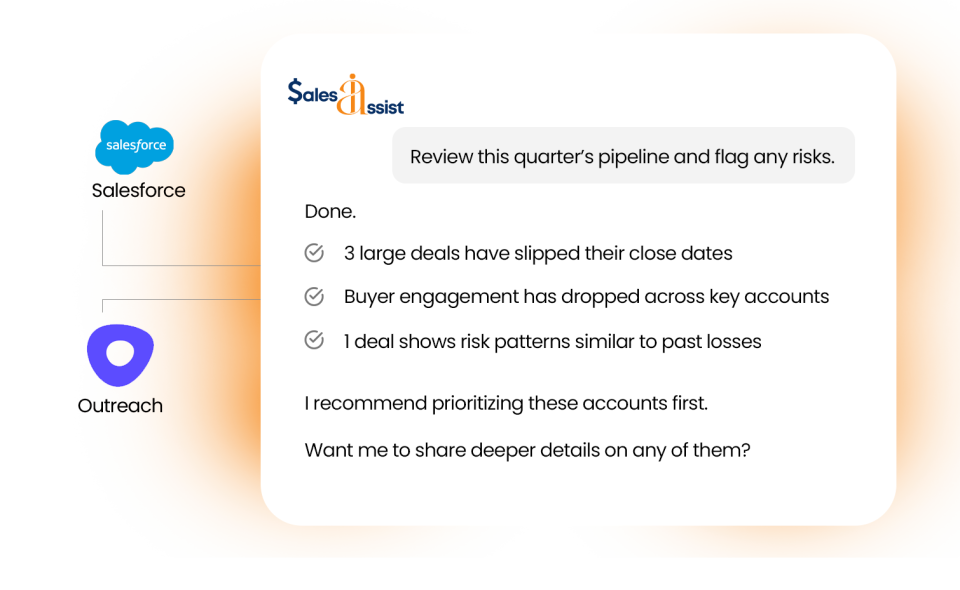
  • Pipeline slippage detection 
  • Buying committee engagement analysis 

Shorten sales cycles without increasing pressure on teams

  • Next-best action recommendations 
  • Deal context summarization 
  • Follow-up prioritization 

Focus effort on opportunities that are likely to convert

  • Buying intent signal analysis 
  • Opportunity qualification indicators 
  • Lead and account prioritization 

Strengthen positioning in competitive deals

  • Competitor mention detection 
  • Battlecard retrieval 
  • Pricing and positioning insights 

Increase revenue from existing customers

  • Cross-sell opportunity identification 
  • Upsell readiness signals 
  • Account expansion tracking 

Built for enterprise sales

Compliance-first

architecture

Role-based access and data security

Audit trails and explainability

Multi-region and multi-team support 

Cloud, on-prem and hybrid deployment

Integrations

Proven outcomes at enterprise scale

3x

faster proposal and quote cycles

29%

of sales rep time reclaimed

18%

improvement in pipeline momentum

35%

reduction in manual operational effort

15-30%

increase in sales productivity

~ 30%

Improved forecast reliability across active pipelines

Proven Success with Enterprise Clients

Background

Improved Competitive Response Time by 30% with Sales AIssist for a Large BFSI Enterprise

Sales teams now track competitor activity and brand sentiment in real time through natural-language queries, replacing delayed manual analysis with faster, insight-driven decisions 

Background

Reduced Contract Risk with Automated Contract Lifecycle Management for a Leading Airline

Contracts are generated, approved, renewed, and tracked automatically, with risks and obligations monitored throughout the lifecycle 

Background

Improved Sales Productivity with Real-Time Salesforce Insights for a Large Pharma Enterprise

Sales teams access live insights and recommendations directly within Salesforce, reducing manual reporting and increasing time spent selling 

Background

Better Sales Preparation and Win Rates with AI-Driven Sales Intelligence for a Manufacturing Enterprise

Customer, product, and meeting information is consolidated to support faster preparation and more confident sales engagement 

Frequently Asked Questions (FAQs)

It reduces operational drag. Manual updates, missed follow-ups, fragmented customer context, and unclear pipeline views all slow enterprise sales teams down. The assistant helps keep work moving without adding more process.

By taking care of background work. Meeting summaries, next-step suggestions, follow-ups, and CRM updates happen with less effort. Reps spend more time with customers and less time navigating systems.

No. Conversations, negotiations, and decisions remain human-led. The assistant provides context and reminders, not autonomy.

By reducing friction across long sales cycles. Buying signals are surfaced, follow-ups don’t slip, and next actions are clearer—especially when multiple stakeholders are involved.

Yes. It’s designed to work within established CRM, email, and calendar environments. No system replacement. No parallel workflows.

Initial impact often shows up in operational areas, where less admin work, better pipeline hygiene, and improved follow-through, before broader performance metrics shift.

Yes. New reps get structured access to past deals, customer context, and proven patterns, reducing ramp time across large teams.

It is. Managers get cleaner pipeline views, earlier risk signals, and more consistent data—making reviews and coaching more grounded.

Enterprise-grade assistants follow access controls, role-based permissions, and security policies. Data stays within approved systems.

Focus on fit, governance, and adoption. If it integrates cleanly, respects controls, and genuinely reduces manual effort, it tends to scale. If not, it becomes shelfware. For organizations standardizing sales operations across regions or teams, this is often a good point to assess fit against existing workflows.

Get started with our Sales Assistant